 Jonjoe1001
How do you teach something to walk without telling it how?
OK guys, this question has been living in my head ever since I played Evolution by @keiwando in middle school. How do you teach a creature to walk if you’re not allowed to tell it what walking is? There are no animations, no walk cycle, and nobody telling it to move the left leg and then the right one. Nothing!
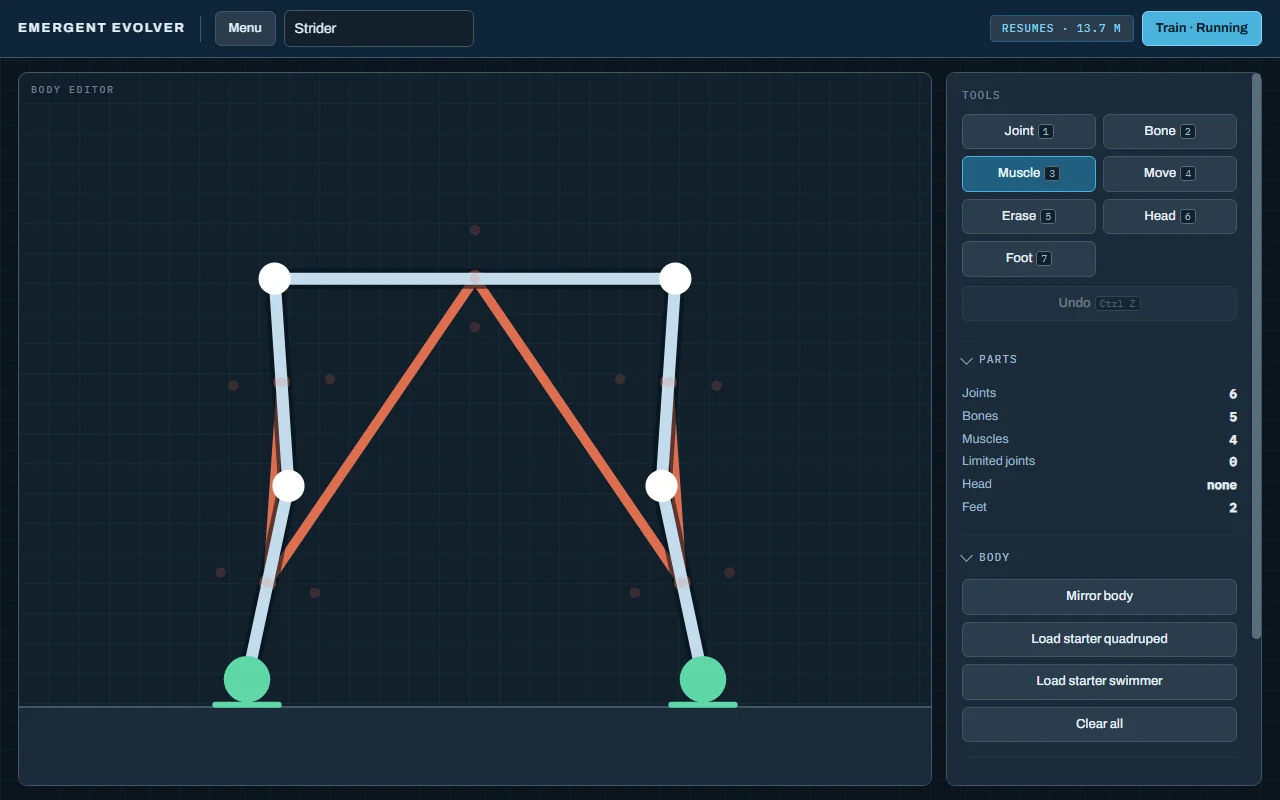
That’s the whole idea behind Emergent Evolver, which just dropped on itch.io (go play it, it’s free!). You draw a body out of joints, bones and muscles, then you hand it to a brain that starts out knowing absolutely NOTHING. A few hundred generations later, the thing runs.
In my last post I promised a write-up of how it actually works, especially the part where the brain grows its own neurons. So here it is, plus my favourite part: all the ways it went wrong. Because it went wrong a LOT.
How does anything learn without a teacher?
Most of the machine learning you’ve heard of learns from examples. You show it a million cat pictures and correct it every time it guesses wrong. But I don’t have a million examples of the weird six-legged thing you just drew walking correctly. Nobody does! There’s no right answer to copy.
So instead it uses evolution, the same basic trick nature used. Every generation, twenty-odd creatures with slightly different brains all attempt the course, and they get scored on one thing: how far they got. The best few get to breed, their kids get a few random mutations, and everyone else gets deleted. Then you do it again. And again. And again.
Early on every brain is basically random noise, so the creatures just twitch and flop around. But one of them flops half a metre further than the others, completely by accident, and that accident gets passed down. Stack enough lucky accidents on top of each other and you get something that looks like it knows exactly what it’s doing. It doesn’t! It’s just the descendant of a very long line of slightly less bad floppers. (Kinda like us, if you think about it.)
What the brain actually is
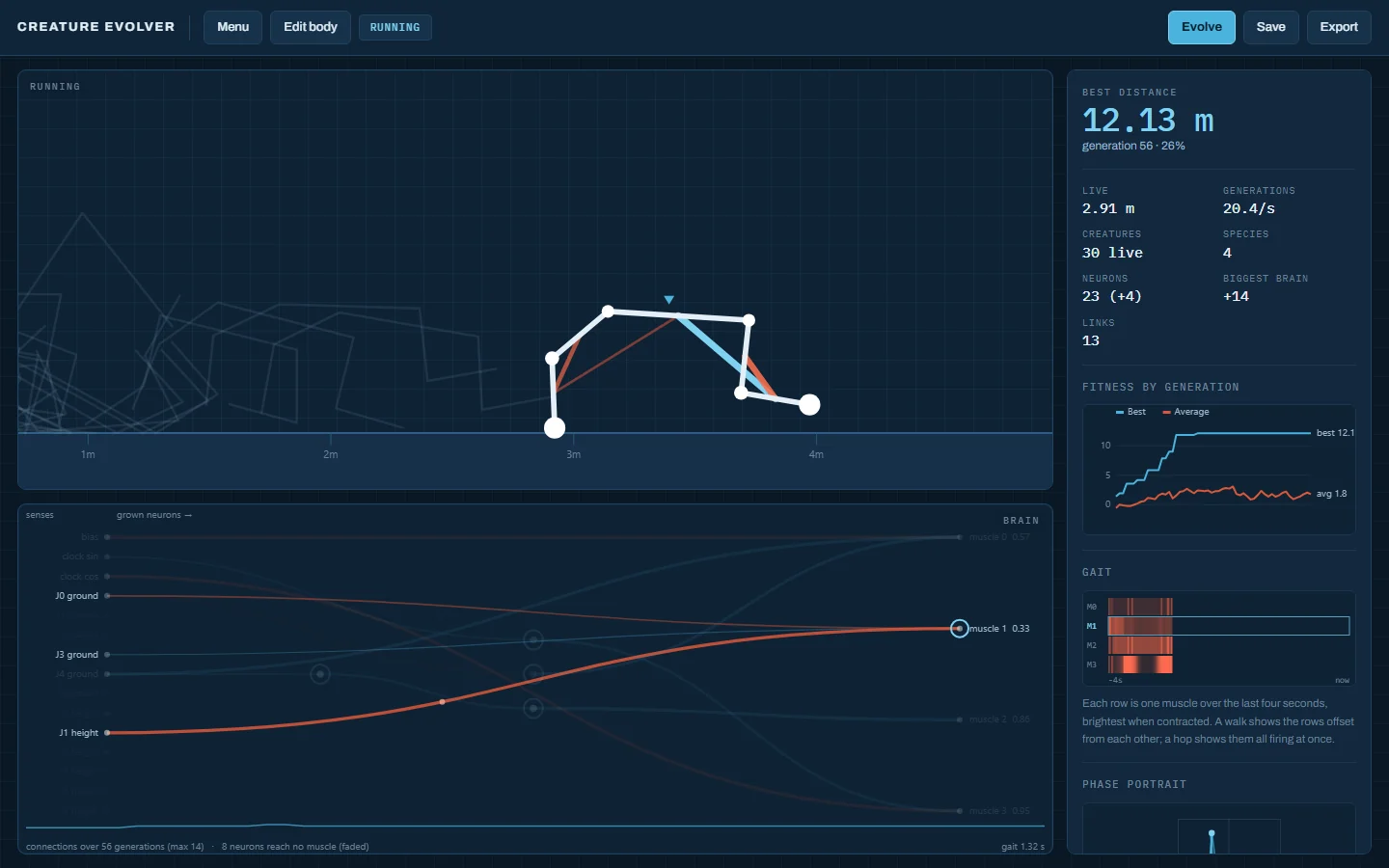
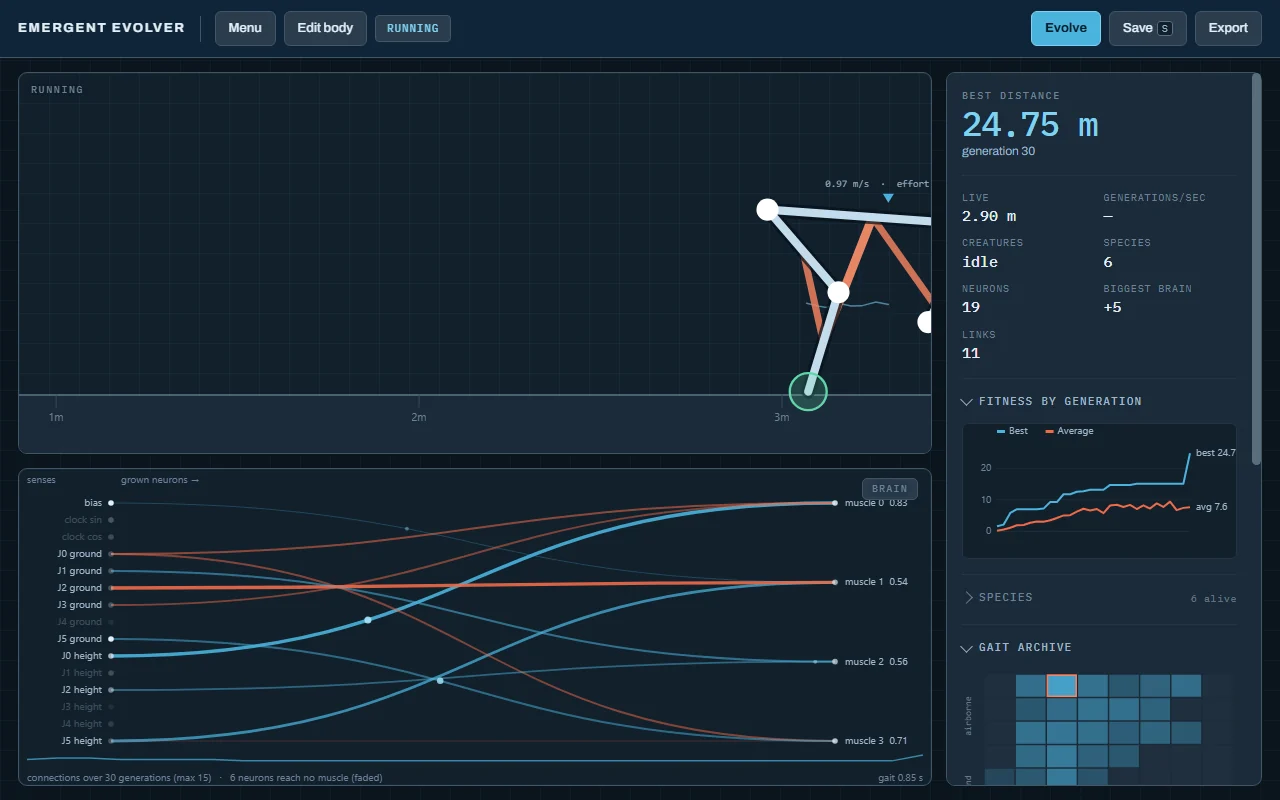
The brain is a small neural network. On one side are its senses: for every joint, is it touching the ground, and how high up is it? There’s also a ticking clock, which I’ll come back to, because it turned out to be a whole thing. On the other side are the muscles, one output each, saying how hard to pull right now. In between are wires with weights on them that decide how much each sense pushes on each muscle.
That’s it! It has no idea what a leg is, no idea which way is forward, and no idea what balance means. It gets numbers in and pushes numbers out.
The brain grows its own neurons
This is the part I was most excited about. Most neural networks have a fixed shape that you pick before training starts. Emergent Evolver uses an algorithm called NEAT (NeuroEvolution of Augmenting Topologies, which is a mouthful, so NEAT). The brain starts with nothing in the middle at all, just senses wired to muscles at random, and mutations can change its actual STRUCTURE. A mutation can:
- nudge how strong a wire is
- add a brand new wire between two neurons that weren’t connected
- cut an existing wire in half and put a brand NEW neuron in the gap
- speed up or slow down the creature’s internal clock
That third one is why you can literally watch the brain grow on screen. Senses sit down the left, muscles down the right, and every new neuron shows up in between as evolution invents it.
New ideas need protecting
Here’s the catch though. A brand new neuron is useless at first. It’s sitting in the middle of a wire doing roughly what the wire already did, and it needs a few more lucky mutations before it’s worth anything. Meanwhile it’s up against creatures that have been fine tuning a simple brain for fifty generations. The new idea gets crushed before it ever gets a chance!
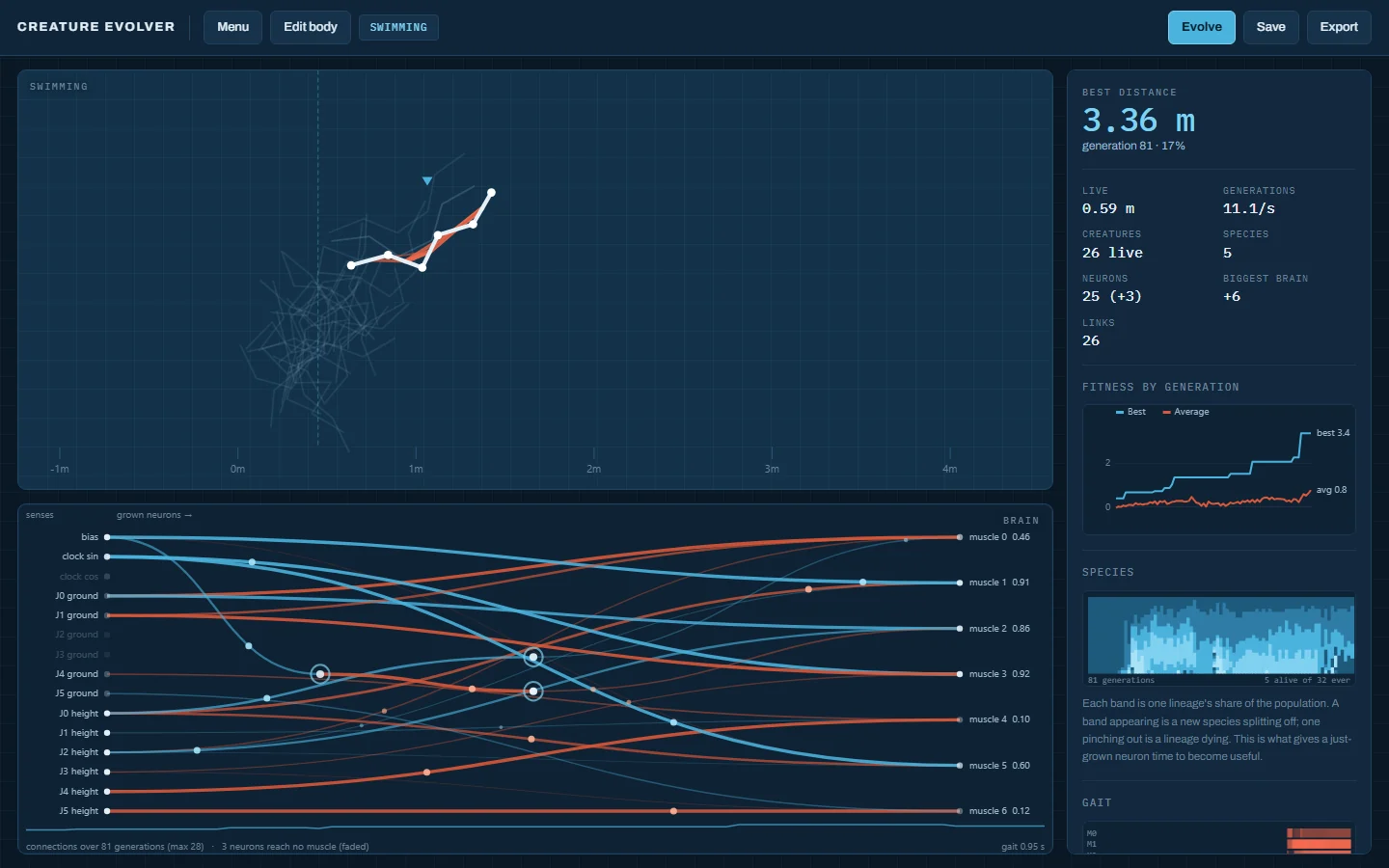
NEAT’s fix is really clever. Creatures get grouped into species by how similar their brains are, and each species mostly competes with itself. A creature with a weird new neuron is only up against other weirdos, so it gets time to figure out what to do with it. The game holds about five species at a time, and in a typical sixty generation run you’ll see around sixteen lineages come and go just to keep those five alive. There’s a chart in the game that shows it, and honestly it’s kind of beautiful watching species split off and go extinct.
I also added a stagnation kick. If nothing beats the champion for twelve generations, the back half of the population gets violently re-mutated. Before that existed, two test runs on the exact same settings finished at 5.4 m and 16.6 m, just depending on whether one of them got stuck.
The clock wasn’t the heartbeat
Remember that ticking clock? I was SURE it was the most important thing in the brain. Walking is rhythmic, right? Left, right, left, right. So the brain would obviously need something rhythmic to drive it.
So I tested it. I took eight champions from eight different runs and switched their clocks off, and four of them didn’t lose a single metre! Then I switched off their sense of touching the ground instead, and seven of the eight collapsed from around 30 m to basically nothing.
So where’s the rhythm coming from? The body! A foot hits the ground, that tells the brain to pull a muscle, the muscle swings the leg, the foot comes up, the brain reacts to THAT, and around it goes. The rhythm isn’t inside the brain at all. It’s a loop that runs through the brain, the body and the floor together, and that honestly blew my mind a little.
I built a tool into the game to check this on any creature, called What is this brain using? It takes each sense and each neuron out one at a time, reruns the creature, and tells you how many metres that part was worth. On a typical champion, one joint’s ground sense was worth the ENTIRE run, the clock was worth about a third of a metre, and 14 of its 21 parts were worth exactly nothing. These things run on two or three senses and a dozen wires!
It also explained two ideas of mine that sounded like upgrades and made things worse. Giving creatures extra senses, like how tilted they are and how fast they’re going, dropped them from 22.9 m to 17.0 m, because it handed evolution a cheap shortcut (lunge whenever you tip over!) that works early and then goes nowhere. And wiring the clock into every muscle cost about six metres, because it locked every muscle onto the same beat, and walking needs your legs doing DIFFERENT things at the same time.
Evolution is a cheater
OK, this is the big one. If there’s one thing I learned making this game, it’s that evolution will cheat every single time you give it the chance. It doesn’t care what you meant, it only cares about the score, and it’ll find the loopholes in your rules way faster than you ever could. Here are my favourites.
The buzzers
The first creatures were fast and horrible to watch. They BUZZED. The brain was making a new decision 60 times a second, and at that speed it found a tiny vibration that exploited the physics and scooted the creature along. Real nervous systems are way slower than the bodies they drive, so now the brain only thinks 20 times a second and holds its command in between, and the twitching calmed right down.
(Full honesty: my test sweep actually liked 30 best. 20 won in playtesting because the creatures just looked better, so that’s what shipped. There are settings for almost everything I talk about. Things that are toggled on make it easiest for players who just wanna make cool stuff. If you wanna dive in, all the controls are in your hands!)
The head skimmers
Two-legged creatures LOVE to fall over and drag themselves, because dragging still counts as distance. Without any rules my biped test creatures were upright only a quarter of the time. So I added a head, a part that isn’t allowed to touch the ground. My first instinct was to be nice about it and give a short grace period, a few frames of head contact for free.
They learned to skim their heads along the floor, each touch just shorter than the grace window! 41% of the run with their face on the ground. Every softer version of the rule got exploited. The strictest one, where any head contact ends the run instantly, got creatures upright 99% of the time AND the best honest distances.
One detail mattered a lot: the run ends, but you keep the distance you already earned. My first try zeroed the score instead, which sounds tougher but worked worse, because tripping at 15 m then scored the same as face-planting on the start line. Evolution couldn’t tell “nearly had it” from “hopeless”.
It doesn’t care what you meant, it only cares about the score!
The ice skaters
Feet are the parts meant to grip the ground, so I gave every other part zero grip, because in my tests zero scored the furthest. Distance went up! Great, right?
Nope. Zero friction doesn’t mean “doesn’t touch the floor,” it means a perfect ice skate. The creatures learned to plant one foot, shove, and glide along on their bellies, and five out of twelve runs spent most of the time belly-down. The number went UP because they’d found an exploit, and I read it as an improvement.
The fix was giving everything that isn’t a foot some real drag, enough that sliding costs you. Belly sliders went to zero, the creatures stood 59% taller, and distance went up too. Letting non-feet keep a little friction was the original plan. I talked myself out of it by chasing one number.
The knee walkers
Even after that, creatures kept walking around on their knees. In the physics a knee and a foot were basically the same thing with different grip, so evolution had no reason to prefer the foot. But grip isn’t really what a foot is for. A real foot is squishy, it soaks up the landing, and bare bone doesn’t. So now any joint that isn’t a foot loses speed when it lands, and the harder it comes down the more it loses. It didn’t make anything faster, but creatures stand on the feet you gave them instead of their shins, which is what I actually wanted.
So why not just take points off?
Notice none of these fixes are score penalties? I never subtract points for sliding or kneeling. I did try a penalty for sliding, and it scored worse on everything else. The problem is that evolution treats a penalty like a price, and it’ll happily find a way to do the thing just under the limit. If the world itself makes a cheat not worth doing, evolution just stops trying. So every fix in the game lives in the world: drag, the landing scuff, the head rule, the slower nerves.
Physics that bit me
The eel that couldn’t swim
Swimming is hard in this game, and for the longest time it was WAY harder than it should have been. The obvious swimmer is a long eel, a straight row of segments with muscles between them. It scored 0.1 m no matter what. I even drove one by hand with a perfect wave and it still went nowhere.
The problem was geometry. Muscles attach at the middle of each bone, and on a perfectly straight body all of those middles sit on one straight line. So every muscle pulls straight along the spine with zero leverage to bend it. The body was completely rigid! It didn’t bend at all, no matter what the brain did.
The fix? A tiny zigzag. Offsetting every other joint by 3 units, which you can barely even see, took the same body from not bending at all to bending plenty. That’s why the game ships with a starter swimmer now, muscled the way a real fish is.
Jumping that ended after one jump
Jumping used to be scored on the single highest point you reached, and every run scored about the same, which is a flatline, not a challenge. When I looked closer, the creatures were dying at step 64 of a 600 step trial. Jump once, land, head hits the ground, run over. The whole thing was decided in the first second! Now jumping adds up every hop, and the head rule is off for it, since landing a hop naturally puts your head down. Suddenly different runs found totally different solutions, and landing well is worth exactly as much as jumping high, because you can’t take the next hop without it.
One run means nothing
This was a big lesson for me, and not just for games. Evolution is random, so two runs on the exact same settings can end up wildly different. Early on I’d change something, run it once, see a better number and get excited. That’s worthless! Every real measurement in this project needed six to twelve runs before it meant anything.
My favourite example: I let evolution reshape the body, and over ten test runs it won eight. Convincing, right? Then I ran eight more and it won four. A coin flip! Together that’s twelve out of eighteen, which is a small effect at best. If I’d stopped after the first batch, I’d be telling you something that isn’t true.
(Body reshaping had its own cheat too, by the way. Left alone, evolution just made creatures BIGGER, because a bigger body covers more ground per step. So the total bone length is locked to what you drew, and a longer thigh has to be paid for with a shorter shin. Where it really shines is swimming: 5.4 m up to 9.6 m.)
So every run in the game uses a seed, the same seed replays a run exactly, and there’s a Benchmark 8 runs button that does the boring part for you. Use it before you believe anything!
Keeping the losers
Here’s something that always bugged me. Every generation, evolution keeps the best creature and throws the rest away. That includes the one that hopped instead of walking and finished two metres behind, which is exactly the creature I’d want to see! I kept noticing my creatures all looked kind of the same, so I measured it, and the population wasn’t converging at all. The variety was there the whole time, it just never made it onto the screen.
So I built the gait archive. It sorts creatures by HOW they move instead of how far: how much of the run they spend in the air, and how high they carry their body. Crawling, shuffling, walking and hopping all land in different squares of a grid, and each square keeps the best creature that ever moved that way. A slow hopper never has to compete with a fast crawler.
Twenty-five generations on the starter body fills half of the 64 squares. In one run the champion was airborne 68% of the time, and the archive was also holding a crawler that barely left the ground and an even bouncier thing at 73%. Neither of those would have survived a single generation normally. Click any square to watch it, and breed from it if you like it better than the winner!
Editing without losing the brain
Last one, and it was by far the hardest to get right. Adding a single joint to a creature used to wipe its brain. The brain is wired to slots, so add or remove a part and every slot after it shifts over, and suddenly the wires that learned about the back leg are pointing at the tail. A thousand generations gone, just because you gave it a tail!
The fix was giving every part a permanent name that never changes. When you edit the body, the game matches old parts to new parts by name and carries across every wire that still makes sense. After 80 generations of training, adding a tail and keeping the brain beat starting fresh six times out of six, 18.5 m against 7.7 m.
It’s not magic though. Giving one creature an extra muscle made it way more capable, and the carried-over brain was too stuck in its old gait to find the new moves. So half the population always starts fresh as a backup, and there’s a Restart from noise button for when you want a clean slate.
What’s next
Right now the archive just watches and remembers. The real version of this idea (it’s called MAP-Elites) actually breeds FROM the archive, picking random squares as parents, and it tends to find stranger things than chasing one score ever does. That’s next on my list, along with touch controls so it works on a tablet.
If you want to see all this in action, go play Emergent Evolver. It’s free and it runs right in your browser. Draw something weird and see what evolution does with it! And if you find a cheat I haven’t closed yet, PLEASE tell me. Honestly that’s my favourite kind of message to get.